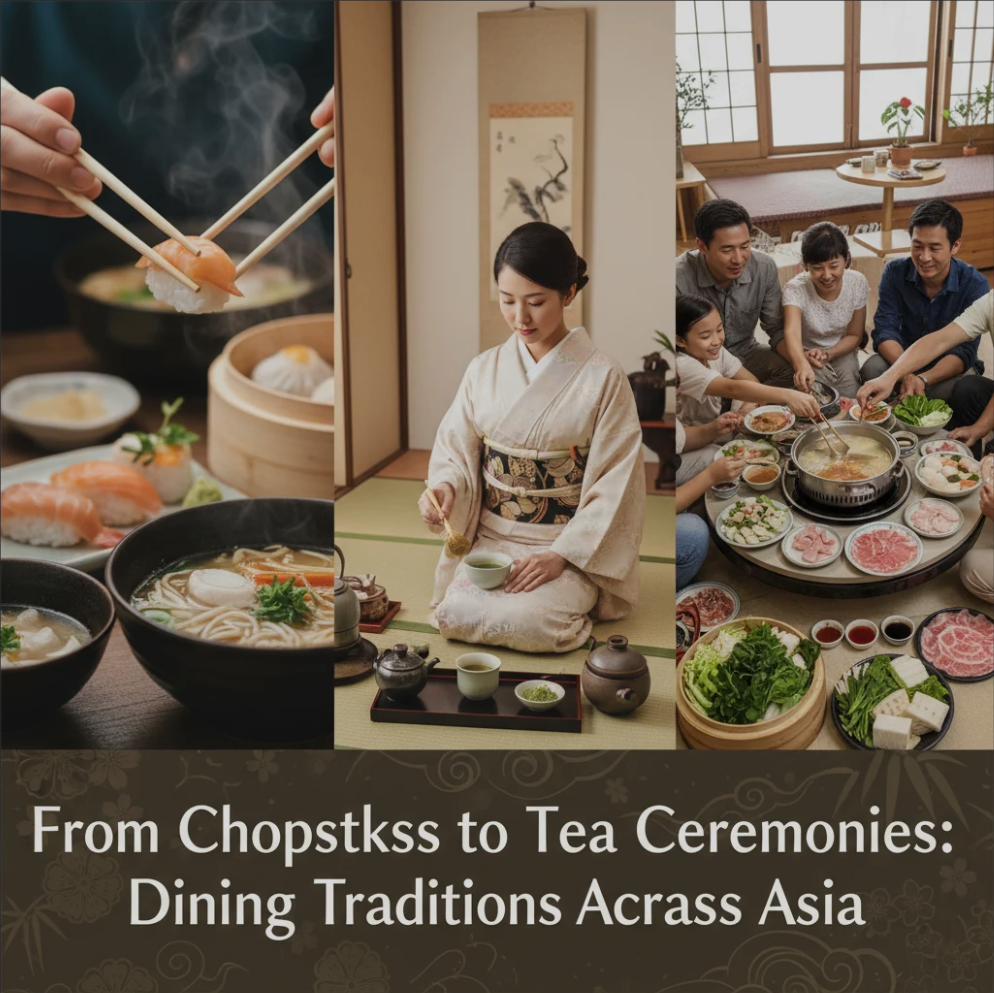

Dining in Asia is more than just eating — it’s a celebration of history, community, and respect.
Across this vast continent, every meal tells a story, from the symbolic use of chopsticks to the grace of traditional tea ceremonies.
Let’s explore how these timeless traditions connect people through flavor and meaning.
🍚 1. The Art of Chopsticks: Simplicity and Skill
Chopsticks may look simple, but they hold deep cultural symbolism.
In countries like China, Japan, Korea, and Vietnam, chopsticks are seen as extensions of mindfulness and etiquette.
China: Long chopsticks represent harmony and reach.
Japan: Using chopsticks properly is considered a reflection of respect.
Korea: Metal chopsticks are used alongside spoons, showing practicality and elegance.
Each gesture — from how you hold them to how you rest them — carries a message of respect for the meal and those sharing it.
🍵 2. The Grace of Tea Ceremonies
In Asia, tea isn’t just a drink — it’s an experience.
From Japanese chanoyu to Chinese gongfu tea and Vietnamese lotus tea, the process reflects mindfulness, patience, and spiritual calm.
The Japanese tea ceremony, for example, is a meditative art form where every motion has meaning — symbolizing purity, harmony, and tranquility.
In China, tea gatherings often signify hospitality and wisdom shared through generations.
💬 “To pour tea is to pour respect,” says a popular Asian proverb.
🥢 3. Dining Etiquette: Respect Above All
Respect is the heart of Asian dining.
It’s seen in the way elders are served first, bowls are held close to the heart, and silence is used to express appreciation.
Some customs include:
Never sticking chopsticks upright in rice (it resembles funeral rites).
Offering dishes to others before serving yourself.
Avoiding waste — every grain of rice symbolizes gratitude.
🍲 4. Communal Dining: Togetherness at the Table
Many Asian cultures emphasize shared dining, where everyone eats from common plates or hot pots.
It’s a reflection of family, community, and equality — no one eats alone.
Whether it’s dim sum in Hong Kong, kimbap in Seoul, or nasi liwet in Indonesia, food is a bridge between generations and traditions.
🌏 5. How Traditions Shape Modern Dining
Even as Asia embraces modern dining trends, ancient traditions remain intact.
High-end restaurants now blend authentic cultural etiquette with modern presentation, creating experiences that honor both heritage and innovation.
From Tokyo to Bangkok, tradition still influences how food is prepared, served, and enjoyed.
💡 Conclusion: A Feast for the Senses and the Soul
From the simple movement of chopsticks to the calming flow of a tea pour, Asia’s dining rituals remind us that food is not just nourishment — it’s a language of love, respect, and identity.
✨ Each meal becomes a timeless connection between past and present — one shared cup of tea at a time.